文/陳宗逸 圖、攝影/胡志祥、陳宗逸 剪輯/黃心怡
為了全力推動「救地球、保台灣全民運動」,前副總統呂秀蓮身體力行聯合國提倡的環保三原則:不吃肉、騎單車、少消費,挑戰這三個項目中,她始終無法突破的「騎單車」這一關。5月18日上午,呂秀蓮和前僑委會委員長張富美、前立委陳秀惠等人,輕車簡從趕赴位在桃園大園鄉的功學社KHS公司全台灣口碑最強的「單車學校」,接受在台灣單車界人氣最高的「單車學校校長」、KHS單車公司董事長謝校長(謝正寬)的指導,準備克服纏繞呂秀蓮數十年的「單車恐懼症」。
呂秀蓮說,遲疑了數十年沒騎單車,是因為小時候「和軍用卡車擦撞」的陰影一直環繞,當年母親嚴禁呂秀蓮騎單車,所以自此之後呂秀蓮就沒有碰過單車。不同於一般政治人物近年來紛紛以「騎單車」塑造親民形象,「恐懼單車」反而是呂秀蓮一直深藏在內心裡「不能說的秘密」。
謝校長鼓勵呂秀蓮,他認為學單車不分年長、年幼,他的單車學校裡,最高紀錄教會不會騎單車的人,是65歲,他認為呂秀蓮幼年時會騎,只是後來沒有接觸,跟完全不會騎車的人不一樣。所以,他保證讓呂秀蓮「短期之內學會單車」。
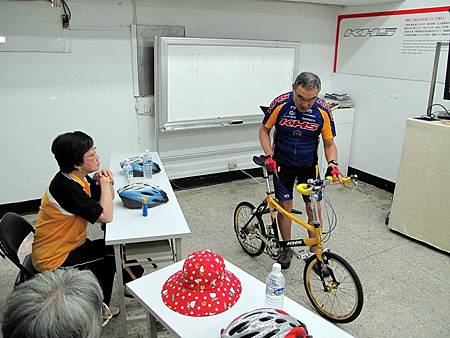
- 謝校長說,認識單車、學會騎單車,第一步就是要學會「煞車」和認識「平衡感」。
-
- 騎單車一定要戴安全帽,第一次戴上安全帽,感覺好特別!
- 戴安全帽之前,還要戴上防風、防汗的多功能頭巾,才不會讓頭部汗水滴下影響視線,造成行車危險。
- 準備上路了!在謝校長的指導之下,要和好姐妹們一起挑戰單車恐懼症!
- 辛苦的練車過程,請看影片:
- 感謝KHS全體員工鼎力支持!KHS是台灣少數「根留台灣」的優秀廠商,也是帶動起這幾年「小折風潮」的先鋒企業。未來呂秀蓮的「救地球、保台灣全民運動」,也將和謝校長有密切的合作,敬請大家期待!
文章標籤
全站熱搜

http://ocw.aca.ntu.edu.tw/ntu-ocw/ocw/cou/100S221/74
我們吃蛇膽長大。 http://ocw.aca.ntu.edu.tw/ntu-ocw/ocw/cou/100S221/73
我舔蛇鞭酒,得了厭食症。
我喝雄黃酒。 http://ocw.aca.ntu.edu.tw/ntu-ocw/ocw/cou/100S221/73
喝雄黃、念雄女。 我們吃蛇膽長大。 http://ocw.aca.ntu.edu.tw/ntu-ocw/ocw/cou/100S221/73
不要掐我脖子。
真·三國無雙8 Empires / Dynasty Warriors 9 Empires PS5 PS4 Switch XBOX seriex x steam 預計2021(PS5、PS4、Switch、Xbox Series X、steam) https://ja.wikipedia.org/wiki/真・三國無双8
https://en.wikipedia.org/wiki/Dynasty_Warriors_9
http://ocw.aca.ntu.edu.tw/ntu-ocw/ocw/cou/100S221/72
新興國際中小學http://learn.hshs.tyc.edu.tw/ischool/publish_page/503/
我待會在室內踩腳踏車。 http://ocw.aca.ntu.edu.tw/ntu-ocw/ocw/cou/100S221/71
https://www.nccu.edu.tw/p/403-1000-122.php?Lang=zh-tw
Supersolids go two-dimensional Supersolids are exotic materials whose constituent particles can simultaneously form a crystal and flow without friction. The first 2D supersolid has been produced using ultracold gases of highly magnetic atoms. Bruno Laburthe-Tolra You have full access to this article via your institution. Download PDF Despite their name, materials known as supersolids1 are not super rigid. Instead, they combine the ordered structure of a solid with the properties of a superfluid — a substance that flows without friction. To picture a supersolid, consider an ice cube immersed in liquid water, with frictionless flow of the water through the cube. In 2019, supersolids were made using ultracold magnetic atoms2–4, but the ordered structure existed in only one dimension. Now, in a paper in Nature, Norcia et al.5 report the observation of a 2D supersolid formed by ultracold dysprosium atoms. Read the paper: Two-dimensional supersolidity in a dipolar quantum gas When a liquid becomes a solid, its density becomes strongly modulated as the ordered array of particles that constitutes a crystal emerges. This regular order, which characterizes solids ranging from ice to metals, is invisible to the naked eye and breaks a type of symmetry known as translational symmetry. For a material to become a supersolid, it must similarly break translational symmetry. Moreover, it needs to exhibit superfluidity, which requires it to behave like a wave that has a well-defined oscillation throughout the material. Scientists first searched for supersolidity using helium atoms at cryogenic temperatures6. When the pressure is varied, such atoms can transition between a solid phase and a superfluid phase, suggesting the possible coexistence of solid and superfluid behaviours. Helium atoms are great candidates for observing supersolidity because, according to quantum mechanics, such ultralight atoms can easily behave like waves. Unfortunately, supersolid helium has remained elusive6. Ultracold atomic gases, produced at temperatures of only about 100 nanokelvin, are other promising candidates for supersolidity because they can become a superfluid through Bose–Einstein condensation — a quantum-mechanical phenomenon in which all the atoms spontaneously organize into a collective macroscopic wave. By placing Bose–Einstein condensates into patterns of laser light, researchers have observed self-arranged arrays of atoms that exhibit superfluidity7,8. However, the periodicity of these crystals is determined by the laser’s wavelength, which means that the material’s lattice structure cannot vibrate like that of a conventional solid. Such systems therefore lack some of the degrees of freedom of supersolids. Quantum gases show flashes of a supersolid For these reasons, scientists were excited in 2019 when three groups announced the production of supersolids based on magnetic Bose–Einstein condensates2–4. These condensates, made using strongly magnetic dysprosium or erbium atoms, are driven by the competition between two types of attractive and repulsive interaction. The experiments operate close to the limit at which the attraction between atoms is strong enough to make the system collapse. Under these conditions, the atoms form an array of droplets. The shape of each droplet is controlled by the competition between the atomic interactions and by an effective pressure resulting from quantum fluctuations. Furthermore, the spatial arrangement of the droplets is governed by the long-range magnetic repulsion between them. In addition to this self-arranged array of droplets, there is a relatively large background gas of roughly uniform density that helps to provide the atomic wave with the well-defined oscillation that is needed for superfluidity. To picture this system, think of a lattice of droplets (corresponding to the solid nature of the supersolid) coexisting with a uniform background gas (corresponding to the superfluid nature of the supersolid) — similar to the image mentioned above of an ice cube immersed in water, with the water flowing through the cube. But bear in mind that the crystal and background gas consist of the same atoms and form a single phase of matter: the supersolid. Whereas these seminal studies made 1D droplet arrays and supersolids, Norcia and colleagues modified the optical trap that confines the atoms to produce a 2D droplet array and supersolid (Fig. 1). This demonstration is a key advance because one direct way to prove that a system exhibits superfluidity is to study its properties under rotation, and this analysis cannot be achieved if the system has only one dimension. Figure 1 Figure 1 | Supersolids formed by an ultracold atomic gas. Supersolids are materials that combine the ordered structure of a solid with the frictionless flow of a substance called a superfluid. Norcia et al.5 made one- and two-dimensional supersolids using an ultracold gas of dysprosium atoms. The colours represent the density of the systems from low (black) to high (yellow). Scale bars, 10 micrometres. (Adapted from Fig. 2b,d of ref. 5.) A superfluid can be rotated only by twisting its corresponding wave in such a way that the superfluid hosts a vortex, similar to a whirlpool in water. The formation of this vortex requires a certain amount of energy, so that, in practice, the superfluid does not rotate until a sufficiently large rotational force is applied to the system. This peculiar behaviour causes the superfluid to have an unconventional moment of inertia — a quantity that measures the extent to which an object resists rotational acceleration. For a supersolid, it is qualitatively expected that the crystal component will rotate like a rigid body, whereas the background gas will not1. Comparing the moment of inertia of the authors’ supersolid with that of an ordinary solid would be one way to determine the fraction of the supersolid that exhibits superfluidity. Another question still to be addressed is to what extent the properties of the supersolid are driven by its limited size. The properties of systems that have long-range interactions, such as the magnetic interactions in the present case, are often driven by the structure of the system’s outer edges. In Norcia and colleagues’ experiment, the droplet array has a structure that is extremely sensitive to the trap, indicating a high sensitivity to such boundary effects9. It remains to be seen whether systems larger than the authors’ supersolid can be made. In the present experiment, the background gas of the supersolid has a healing length (a quantity that, for example, determines the size of a vortex core) that is probably much smaller than the material. This observation indicates that the system is already large enough to host vortex arrays10 and other excitations associated with the symmetries and structure of a supersolid. The full study of the dynamical properties of this phase of matter will be an exciting research topic in the next few years.
Physicists give weird new phase of matter an extra dimension By Ben Turner 3 days ago The supersolid's atoms can move without ever losing energy An artist's impression of the supersolid, which is like a solid and a liquid at the same time. An artist's impression of the supersolid, which is like a solid and a liquid at the same time. (Image credit: IQOQI Innsbruck/Harald Ritsch) Physicists have created the first ever two-dimensional supersolid — a bizarre phase of matter that behaves like both a solid and a frictionless liquid at the same time. Advertisement Supersolids are materials whose atoms are arranged into a regular, repeating, crystal structure, yet are also able to flow forever without ever losing any kinetic energy. Despite their freakish properties, which appear to violate many of the known laws of physics, physicists have long predicted them theoretically — they first appeared as a suggestion in the work of the physicist Eugene Gross as early as 1957. Now, using lasers and super-chilled gases, physicists have finally coaxed a supersolid into a 2D structure, an advancement that could enable scientists to crack the deeper physics behind the mysterious properties of the weird matter phase. Related: 12 stunning quantum physics experiments RECOMMENDED VIDEOS FOR YOU... Of particular interest to the researchers is how their 2D supersolids will behave when they're spun in a circle, alongside as the tiny little whirlpools, or vortices, that will pop up inside them. Advertisement "We expect that there will be much to learn from studying rotational oscillations, for example, as well as vortices that can exist within a 2D system much more readily than in 1D," lead author Matthew Norcia, a physicist at Innsbruck University's Institute for Quantum Optics and Quantum Information (IQOQI) in Austria, told Live Science in an email. To create their supersolid, the team suspended a cloud of dysprosium-164 atoms inside optical tweezers before cooling the atoms down to just above zero Kelvin (minus 459.67 degrees Fahrenheit, or minus 273.15 degrees Celsius) using a technique called laser-cooling. Firing a laser at a gas typically heats it up, but if the photons (light particles) in the laser beam are traveling in the opposite direction of the moving gas particles, they can actually cause slow and cool the gas particles. After cooling the dysprosium atoms as far as they could with the laser, the researchers loosened the "grip" of their optical tweezers, creating just enough space for the most energetic atoms to escape. Since "warmer" particles jiggle faster than cooler ones, this technique, called evaporative cooling, left the researchers with just their super-cooled atoms; and these atoms had been transformed into a new phase of matter — a Bose-Einstein condensate: a collection of atoms that have been super-cooled to within a hair's breadth of absolute zero. When a gas is cooled to near zero temperature, all its atoms lose their energy, entering into the same energy states. As we can only distinguish between the otherwise identical atoms in a gas cloud by looking at their energy levels, this equalizing has a profound effect: The once disparate cloud of vibrating, jiggling, colliding atoms that make up a warmer gas then become, from a quantum mechanical point of view, perfectly identical. This opens the door to some truly weird quantum effects. One key rule of quantum behavior, Heisenberg's uncertainty principle, says you cannot know both a particle's position and its momentum with absolute accuracy. Yet, now that the Bose-Einstein condensate atoms are no longer moving, all of their momentum is known. This leads to the atoms' positions becoming so uncertain that the places they could possibly occupy grow to be larger in area than the spaces between the atoms themselves. Instead of discrete atoms, then, the overlapping atoms in the fuzzy Bose-Einstein condensate ball act as if they are just one giant particle. This gives some Bose-Einstein condensates the property of superfluidity — allowing their particles to flow without any friction. In fact, if you were to stir a mug of a superfluid Bose-Einstein condensate, it would never stop swirling. Advertisement The researchers used dysprosium-164 (an isotope of dysprosium) because it (alongside its neighbor on the periodic table Holmium) is the most magnetic of any discovered element. This means that when the dysprosium-164 atoms were supercooled, in addition to becoming a superfluid, they also clumped together into droplets, sticking to each other like little bar magnets.
Strange supersolid state of matter created in new dimension By Michael Irving August 19, 2021 Facebook Twitter Flipboard LinkedIn An artist's impression of a two-dimensional supersolid, where all the atoms line up in a crystalline structure like a solid but can flow freely at the same time An artist's impression of a two-dimensional supersolid, where all the atoms line up in a crystalline structure like a solid but can flow freely at the same time IQOQI Innsbruck/Harald Ritsch View 1 Images Besides the basic well-known states of matter – solid, liquid, gas and plasma – there are many exotic states being conjured up in the lab. One of these, known as a “supersolid,” was only confirmed a few years ago, and now researchers at the University of Innsbruck have created it in a new two-dimensional form. A supersolid isn’t what it may sound like. Essentially, its atoms are arranged in a rigid crystalline structure, like a regular solid – but they can also flow with zero viscosity, like a superfluid. That sounds like a paradox, but scientists have thought it to be theoretically possible since the 1960s – and in 2017 it was finally experimentally confirmed. More Stories A diagram shows how external sensors (left) could measure the changing distances between implanted magnetic beads (right) The future of prosthetic limb control may be magnetic The PhonoGraft is a new 3D-printable implant to repair the eardrum Harvard's 3D-printed eardrum repair patch is ready for market Several teams of researchers have made supersolids using another state of matter called a Bose-Einstein condensate (BEC). These are made up of a low density gas cloud of atoms cooled down to almost absolute zero, and at that point, they exhibit strange quantum quirks that aren’t normally seen on such a large scale. All the atoms in the BEC exist at every point within the cloud at the same time, in a phenomenon called delocalization. In previous experiments, supersolids were only made one-dimensional, so that the atoms could only flow in one direction. Now, the Innsbruck team has given them a whole new dimension to play in, like upgrading them from moving along a string to moving around a piece of paper. This BEC was made of dysprosium atoms, and magnetic interactions between the atoms caused them to arrange themselves into droplets, which themselves lined up in a grid. “Normally, you would think that each atom would be found in a specific droplet, with no way to get between them,” says Matthew Norcia, an author of the study. “However, in the supersolid state, each particle is delocalized across all the droplets, existing simultaneously in each droplet. So basically, you have a system with a series of high-density regions (the droplets) that all share the same delocalized atoms.” The team says that this breakthrough could allow physicists to study a whole new range of quantum weirdness that a one-dimensional supersolid cannot. “For example, in a two-dimensional supersolid system, one can study how vortices form in the hole between several adjacent droplets,” says Norcia. “These vortices described in theory have not yet been demonstrated, but they represent an important consequence of superfluidity.” The research was published in the journal Nature. Source: University of Innsbruck via Eurekalert
Supersolidity enters a second dimension 18 Aug 2021 Artist's impression of a two-dimensional supersolid quantum gas Supersolid result: Physicists have produced a two-dimensional supersolid quantum gas in the laboratory for the first time. (Courtesy: IQOQI Innsbruck/Harald Ritsch) Atoms in a Bose-Einstein condensate (BEC) can exist in a mysterious “supersolid” state in two dimensions, researchers in Austria have shown. The work, which builds on research from 2019 demonstrating supersolidity in one dimension, opens the way to hitherto impossible tests of theoretical predictions about this long-unexplained phenomenon. Supersolidity is a counterintuitive state of matter that was first predicted in 1957 by the theoretical physicist Eugene Gross. At temperatures near absolute zero, Gross reasoned that vacancies in crystals of bulk solid helium-4 could condense into a superfluid that would flow through the solid. Gross’ original conjecture remains unproven: a purported 2004 discovery was, in 2012, shown by the same researchers to be the result of experimental error. Subsequent studies have produced nothing definitive. Physicists have had more success, however, by starting from superfluids and working in the opposite direction. BECs (ultracold gases of trapped atoms all cooled to the quantum ground state of the trap) of highly magnetic atoms can spontaneously form regular, ordered clusters in an applied magnetic field, showing the emergence of supersolidity from a completely isotropic superfluid state. “The atoms inside the gas are all phase coherent, and they figure out that if they pile one on top of the other head-to-tail they can decrease their energy,” explains Francesca Ferlaino, an experimental atomic physicist at the University of Innsbruck and the Institute for Quantum Optics and Quantum Information. “In principle they could try to make an infinite filament, but actually they cannot do this because there is a kinetic energy cost and there is a trapping potential cost.” Instead, the atoms form a series of regularly spaced piles, leading to a lattice of peaks in their shared wavefunction. This produces a crystalline order in the atoms’ density, even though each individual atom is completely delocalized. From one dimension to two That’s the theory. In practice, while three groups – including Ferlaino’s – achieved emergent crystalline order in superfluids in one dimension in 2019, nobody managed it in two dimensions. This severely limited researchers’ ability to perform experiments on supersolidity using quantum gases. “The interesting physics is in the behaviour of the crystals – the transport of the particles, the type of excitations that you can create,” Ferlaino explains. However, creating 2D supersolidity in a quantum gas was expected to be far from trivial: “There was this idea in the community that to reach 2D supersolidity would be much, much more difficult and would require many more atoms that were maybe at the limit of what experiments could do,” she says. To overcome this barrier, Ferlaino’s group worked with theorists led by Luis Santos of the Institute for Theoretical Physics in Hanover, Germany. By calculating precisely how tailoring the shape of the trapping potential would alter the shape of the wavefunction – and thereby allow the researchers to turn a linear supersolid into a 2D one – the theorists “identified a way to enter into the supersolid state which was not clear”, Ferlaino says. Using these tailored traps, the experimentalists showed how, depending on the field they applied, cooling the atoms might produce an unmodified condensate, a state comprising separate droplets or – in a very narrow range between the two – a supersolid. Progress through competition Giovanni Modugno, a physicist at the University of Florence, Italy whose group (including the theorists in the present work) published another of the 2019 observations of one-dimensional supersolidity, is impressed. “Normally when you have bosonic particles at zero temperature, they go to the ground state of the system, which is a wavefunction with no nodes and no modulations,” he explains. “What is extraordinary here is that we are still in the ground state of the system, but we have these places where the wavefunction almost reaches zero but doesn’t really: from the point of view of textbook quantum mechanics, these modulations are something extraordinary and extremely difficult to realise. That’s why it took 50 years or more.” Read more Supersolid behaviour spotted in dipolar quantum gases “The one-dimensional supersolids kind of appeared two years ago and it was a really big surprise when three groups overcame that hurdle,” adds theorist Blair Blaikie of the University of Otago in New Zealand, who was not involved in the latest research. “Maybe because of that competition things have really progressed quite quickly. This two-dimensional system just has a lot more features we expect of a supersolid. There’s still a lot of deep theoretical questions about the transitions between different crystalline arrangements and the nature of the phase transitions, and I think there will be a lot of interest in using this system to answer some of these questions.” Ferlaino is keen to start answering these questions, too. “Now we’ve produced this new state, we have many things we want to study,” she says. “We want to know, say, the dispersion relation, and to study the out-of-equilibrium dynamics.”
量子力學 台大易富國教授 82 部影片觀看次數:64,144次上次更新日期:2014年7月9日 本影集教材師法Dirac的思路,以光子的偏振態為實例,做為量子力學的切入點,有別於現今多數量子力學教科書以1/2自旋系統為例的切入點。在今日TFT-LCD螢幕、real-3D影視應用普及的時代,光子的偏振性隨時隨地即可檢證。 本教材的主要內容是以量子力學基本的思想及數學架構為主體。 量子力學起源於1900年,真正量子力學的完成大約在1925-1926年間,目前量子力學的教科書皆以P.A.M. Dirac的著作《The Principle of Quantum Mechanics》為藍本,此書包含所有量子力學的基礎,雖然成書約在80年前(1930年出版第一版),但值得所有對物理有熱情、有興趣的人花時間仔 細閱讀;篇幅不長,大約300頁,但可說是字字珠機,值得細細玩味。 本課程以量子力學聖經《The Principle of Quantum Mechanics》為主要教科書。課程教學不在快慢,而在於是否精準深刻;這是我教學的所關心的事情,而這本書也要用這種心情來讀。 然而,這不是一本易讀的書,基本上不太適合用來當作教科書,我之所以敢用這本書,是取他最重要的、最精髓的部分,其他部分可以用別的材料來讀。 讀這本書及這門課的預備知識,可以觀看CAStudio【普通物理學甲下】第22講、第25~33講,為量子力學所準備的章節;及【進階電磁學】第8~13講關於最小作用量原理的教學,再加上第26到30- 2 講,做為量子力學課程的預備知識。 關於量子力學的應用,除了易教授的教學錄影之外,化學系的鄭原忠教授在【量子化學】所有的教學錄影,對於量子力學應用在原子、分子物理中,有非常精道的見解,可同時配合觀看。